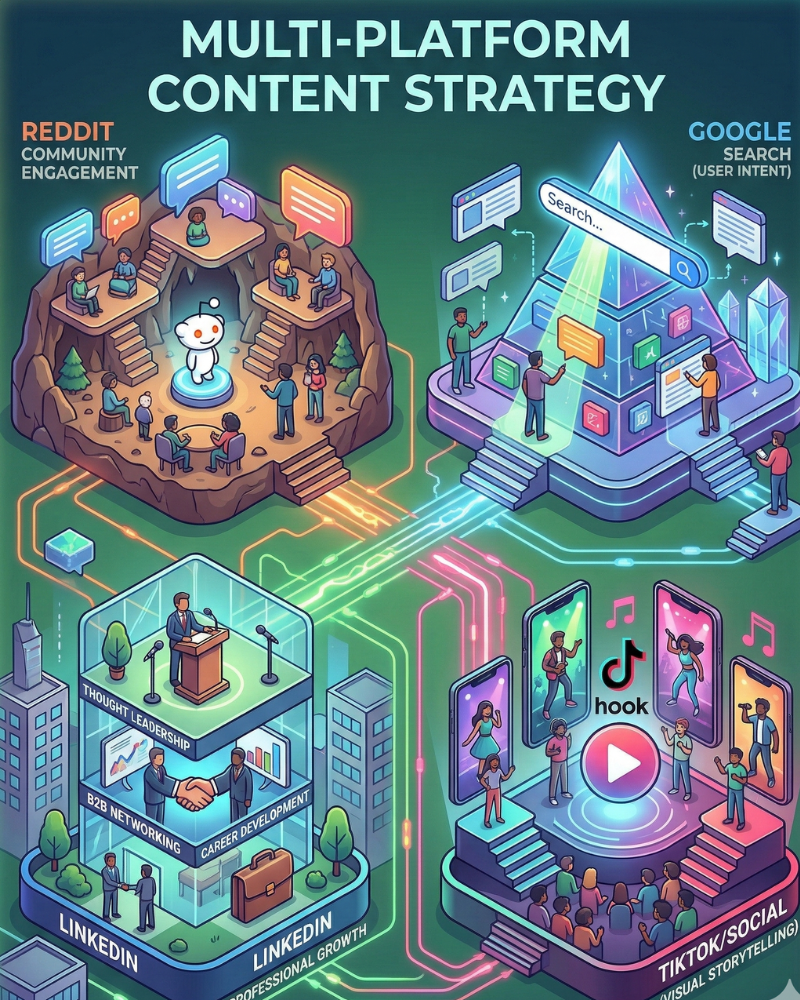
Initially, the content strategy for online publications was quite straightforward; a writer would generate a blog post, stuff it full of keywords, and publish that link everywhere – whether on Facebook, message boards, or email blasts – use the same content links. But with the way people use the web has changed – today, sites such as LinkedIn, Reddit, TikTok, and Google all exist in their own environments with different rules, advanced forms of algorithmic development, and most importantly to this discussion, very different ways people think about them.
In a recent “Ask An SEO” column, Search Engine Journal posed one of the most important questions faced by marketers today – “Should marketers optimize their content according to the platform it is hosted on?” The clear answer is “Yes”.
As marketers, if you want to create the maximum amount of reach and be able to sell products from your content, you need to treat a person looking for a product via Google completely differently from one that is looking for a product via Reddit.
This guide discusses how to use metadata, on-page experience, and publication on a platform-specific basis to create effective content for our audiences across the continuum of attention spans we see today.
Section One: The Psychological State of the Platform (Understanding What People Want)
Prior to actually reviewing the variables of optimization techniques individually, it is crucial that marketers understand why an audience member visits the platform – optimization is about more than how many characters were used. Each audience member will have their own expectations of what will happen on that site and this will be affected by their own psychology.
The Seekers of Discovery through Social Media
The activity of using social media on platforms such as Instagram, TikTok, and Facebook is often done via “passive” mode; thus, users could simply be seeking entertainment/distraction and/or looking to connect with others who have similar interests and might not even want to be influenced in any way regarding purchasing a product. To get their attention through social media your content must contain “interruptive” qualities with a “hook” or item that will cause users to stop scrolling. For example, the search engine optimized headline, “10 Benefits of Organic Green Tea,” may fail to generate interest and engagement on Facebook, while a headline like, “The One Morning Habit That Changed My Energy Levels Forever,” could create viral curves.
The Seekers of Truth via Community Hubs
Reddit and LinkedIn provide a middle ground of sorts for users who use these platforms to gain knowledge from others about various topics, as both Reddit and LinkedIn are community-engaged learning hubs; however, they each provide a unique platform for discovery. While Reddit users seek information from others, many of whom have used various products or have first-hand experience utilizing those products, they are extremely sensitive to the use of what is labelled as “corporate language” and are vehemently opposed to traditional forms of advertising. Conversely, users on LinkedIn approach the platform from a more professional and formal standpoint, seeking information that can help them connect with others in their respective industries, learn more about their field of interest, and advance their professional career. Therefore, to be effective in using Reddit and LinkedIn, your content must maintain a “value-first” approach that is achieved by providing information within the platform itself and not simply dropping a link to another source or website.
Section 2: Getting it right with metadata on all platforms
Your titles, descriptions, and preview images make up the metadata you’ll use for access point for the viewer onto the content behind that entry point on a website. Therefore, if your access point, or the front door to your content, doesn’t fit the neighbourhood the door is in, then nobody will go through the door, or engage with the content behind the door.
How to tailor title and description
Every platform has different amounts of “real estate,” or length of text they’ll allow you to create for their search engine.
As an example, Google limits how many pixels can be displayed in the title or a description. Should your title & description’s length exceed the “real estate,” then a period (“…”) will replace whatever portion of text is cropped off the title. To help tell Google you’re relevant to the search engine, it is helpful to place your primary key words towards the front of the title.
For use in social media, the character count may be greater. However, you will also have to compete against your friend’s pictures and current “meme” trends. Therefore, the metadata that you will create for use in social media should be written as follows: It should play to the viewer’s emotional interest, use their curiosity, or use a very strong value proposition; so that they are compelled to click on the link to see the content.
Demographic customization
The Search Engine Journal article provides a great article on this topic. Make sure you check your demographics. If your LinkedIn audience is 70% male business executives and your Pinterest audience is 80% female hobbyists, you are wasting your time by creating and using the same title/image combination on both platforms.
Action Step: Use the platform’s analytics data to see who is clicking. Revise your Open Graph tags (data which tells social media how to display your link) so that they are more specific to those individual users.
In part 3 we will look at how to make the most of the content on your webpage to create experiences that lead to the same goal. One advanced tactic is to create experiences based on where visitors come from. This might seem like it could cause “duplicate content” problems but using tags for different experiences is a powerful way to get more conversions.
Lets say a company is selling a high-end espresso machine. They might get visitors from searches and sources.
Case Study: High-End Espresso Machine
Example 1. The Buyer: Someone searches for “buy espresso machine.” When they click on the webpage they see the price, an “Add to Cart” button and technical details about the machine. They are ready to buy.
Example 2. The Social Media User: They saw an ad on showing how to make the perfect cup of coffee. They might not know the brand. Won’t trust it if they land on a page that only shows the “Buy Now” button. They need to see a page before buying which could include a video, on how to use the machine and the benefits of the taste.
## How to Have Two Versions of the Same Page
To have two versions of the espresso machine webpage you will have:
Page 1. The Conversion First Page that people will land on when they come from search engines.
Page 2. The Education First Page that people will land on when they come from media
Part 4: Winning the “Platform-Specific” Game To really do well you have to be willing to leave your website behind sometimes. Each platform has its way of doing things and it wants to keep people on that platform. If you just post links to your site the platform might limit how many people see your stuff.
Reddit: The “AntiMarketer” Haven
On Reddit you should not just post a link. You should write a summary of what you found right in the subreddit. Share the parts of the content. At the end you can say, “I wrote more about this with charts here [Link] if anyone wants to see it.” This helps people trust you. Prevents you from getting banned for sending spam.
LinkedIn: The Thought Leadership Approach LinkedIn likes it when you write a lot of text. Of sharing a link to your blog take the three most important points from your blog and turn them into a long LinkedIn post. Use 3-5 hashtags that’re relevant. By the time people get to the link at the bottom you have already shown them that you know what you are talking about.
Video Platforms like YouTube and TikTok Doing well on these platforms is not about writing text it is about getting people to interact with your videos.
YouTube Shorts: The description of your video is often hidden so you have to tell people what to do in the video itself or show it on the screen.
You also need to think about how people will find your videos. YouTube is like a search engine. Even if you are trying to get people to see your videos on media you need to use keywords in the name of your video file the title of your video and what you say in the video. This is because computers can now listen to videos to figure out what they are, about.
The Search Engine Journal article talks about an approach called “Tiered Approach”.
Tier 1: Your “Power Pages” (Top 5%)
These are the pages about your high-revenue products or your popular blog posts. For these pages you should do everything you can:
Make landing pages for people who come from search engines and for people who come from social media.
Make images for every platform.
Write summaries by hand for Reddit and LinkedIn.
Tier 2: The “Middle Ground” ( 20%)
For these pages do not make pages but change the metadata. Use a plugin like Yoast or RankMath to set a title and image for social media than for search engines. This takes five minutes but can double the number of people who click on your link on Facebook or X.
Tier 3: The Rest (Bottom 75%)
For your pages just make sure they work well for Google and let the social media previews happen on their own.
The Future of Optimization is Contextual.
The internet is not one big web anymore. It is like a bunch of gardens. A person on Reddit is thinking differently than a person on Google or a person reading their email.
Should you make your content different for each platform? Yes. By changing your metadata to fit the needs of each site making your page work well for what the user wants to do and being respectful of the rules of platforms like Reddit and LinkedIn you do more than just make your page work well for search engines. You make the experience better for the user.
In todays world the successful brands are not the ones that shout the loudest to everyone. They are the ones who know how to talk to people in the way on each platform.
Whether it is a 15-second video on TikTok or a long 2,000-word guide the goal is the same: meet the user where they are, on the internet.